Mara Baumann · 30 September 2026
Milora's Fiber Testing Labs Reveal How Decades-Old Italian Weave Patterns Hold Up Under Modern Stress Simulations
Researchers at Milora's fiber testing labs have subjected decades-old Italian weave patterns to rigorous modern stress simulations, and the results provide detailed data on durability across multiple conditions. These patterns, many originating from traditional looms in regions like Tuscany and Piedmont, undergo cycles that replicate daily wear in contemporary interiors and apparel, including repeated tension, abrasion, and exposure to variable humidity levels. The work connects historical textile techniques with current performance metrics, and observers note that the labs track metrics such as thread breakage rates and color retention after thousands of simulated use hours.
Setup of the Testing Environment
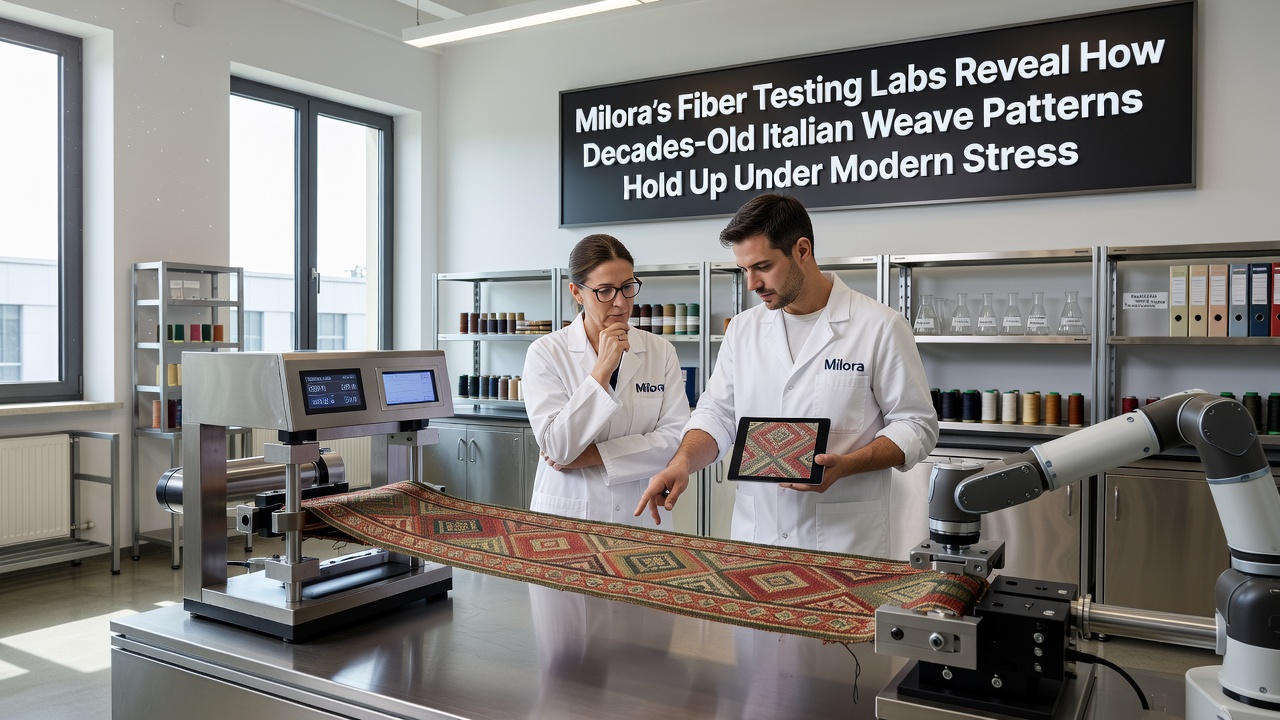
The facilities house specialized equipment that applies controlled forces to fabric samples while monitoring structural changes in real time, and technicians calibrate machines to match standards from the European Committee for Standardization. Samples come from archived bolts dating back to the mid-twentieth century, and each piece receives identification tags that record original fiber composition, dye sources, and loom settings before any stress begins. Environmental chambers adjust temperature and moisture to mimic seasonal shifts in homes and offices, while mechanical arms stretch and rub the weaves against standardized surfaces that represent furniture frames and flooring materials.
Patterns Selected for Examination
Four distinct Italian weave structures form the core of the current series, including a herringbone variation from the 1950s, a diamond twill common in upholstery, a plain weave with supplementary weft floats, and a satin-based pattern used in lighter drapery. These selections represent different yarn densities and interlacement styles that once served rural and urban markets across Italy, and lab staff cross-reference each pattern against regional archives to confirm authenticity before testing starts. Preparation involves cutting uniform swatches that preserve selvedge edges, and baseline measurements capture initial tensile strength plus microscopic images of the yarn intersections.
Simulation Protocols and Data Collection
Each test cycle runs for a minimum of 5,000 repetitions under loads that scale from light to heavy use, and sensors log elongation, pilling formation, and shifts in weave alignment at regular intervals. Humidity levels cycle between 30 and 80 percent while ultraviolet lamps simulate window exposure for set durations, and separate trials introduce chemical stressors that replicate cleaning agents commonly applied today. Data logs feed into software that generates graphs showing progressive degradation, and technicians compare outcomes against control samples stored in stable conditions. The approach follows methods described in reports from the Textile Institute, and results feed into databases accessible to conservation specialists.
Outcomes from the Stress Trials
Findings indicate that the herringbone pattern retained over 85 percent of original tensile strength after abrasion cycles, while the diamond twill showed minimal distortion in the cross-grain direction even after humidity swings. The satin-based weave experienced earlier surface wear on float areas, yet core interlacements held without significant unraveling, and the plain weave with supplementary floats demonstrated strong resistance to pilling when compared against modern equivalents. Color fastness varied by original dye batch, with natural pigments holding better under lower light exposure than expected, and researchers recorded these variations in spreadsheets that allow direct comparison across patterns. Additional trials in September 2026 will expand the dataset with accelerated aging that includes ozone exposure, and preliminary runs suggest the older weaves may outperform some contemporary synthetics in specific humidity ranges.
Connections to Broader Textile Research
Collaborations with academic groups at institutions in Italy and Canada allow cross-validation of the simulation results against field data from historic buildings, and one study coordinated with Politecnico di Milano supplied comparative figures on regional yarn sourcing that help explain why certain patterns resisted deformation better than others. The labs also reference protocols from the International Organization for Standardization to ensure measurements align with global benchmarks, and this alignment supports future applications in restoration projects where original fabrics must meet updated performance codes. Patterns that showed strong results now enter consideration for scaled production runs that preserve the original structures while incorporating minor fiber reinforcements identified during testing.
Conclusion
The testing program continues to generate records that map how specific weave geometries respond to combined stressors, and the accumulated data supports decisions about which historic patterns can transition into modern manufacturing without loss of character. Ongoing work tracks long-term behavior beyond initial cycles, and updates scheduled for late 2026 will incorporate feedback from makers who apply the tested patterns in real installations. This methodical approach supplies concrete metrics that link Italy's textile past with present-day requirements for durability and appearance retention.